


If you work in Learning & Development (L&D), you are likely fighting a war on two fronts.
On one side, you have a workforce desperate for growth: 66% of employees believe they need new skills to stay relevant, and 67% are specifically asking for training on AI tools.
On the other side, you have the reality of the "Zoom era." You organize a mandatory training session, 50 people log on, and within five minutes, 40 of them have turned off their cameras. You are speaking to a wall of black screens. The content might be world-class, but if the cognitive presence of your audience has checked out, the ROI of that session is zero.
The Problem: Most Training Isn't Working
The data confirms what trainers already feel.
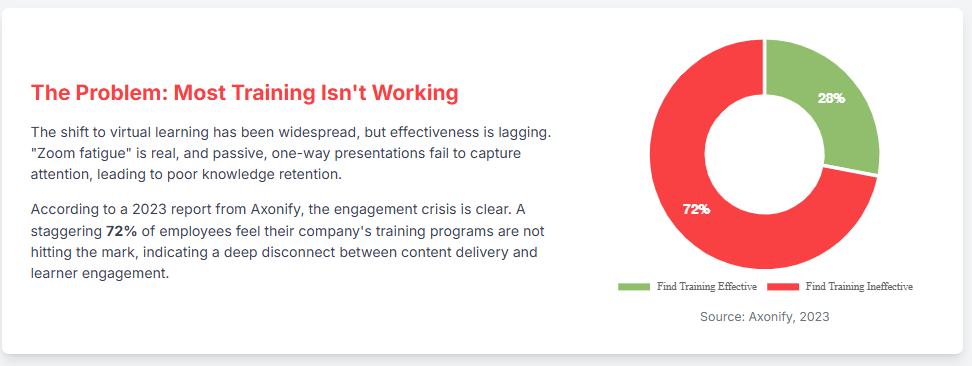
According to a 2023 report from Axonify, a staggering 72% of employees feel their company's training programs are not hitting the mark. This indicates a deep disconnect between content delivery and learner engagement.
And L&D leaders know it.
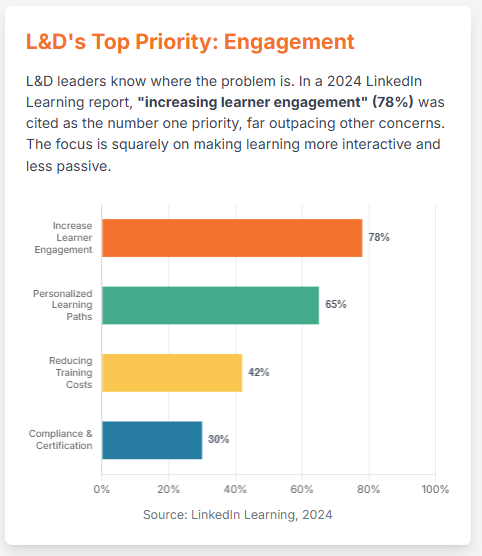
In a 2024 LinkedIn Learning report, "increasing learner engagement" (78%) was cited as the number one priority, far out pacing other concerns. The focus is squarely on making learning more interactive and less passive.
The solution isn't just "more Training". It’s frictionless AI.
The AI Investment is Pouring In
To address the gap, companies are hoping that AI will address their training woes. And hence are investing heavily in AI.
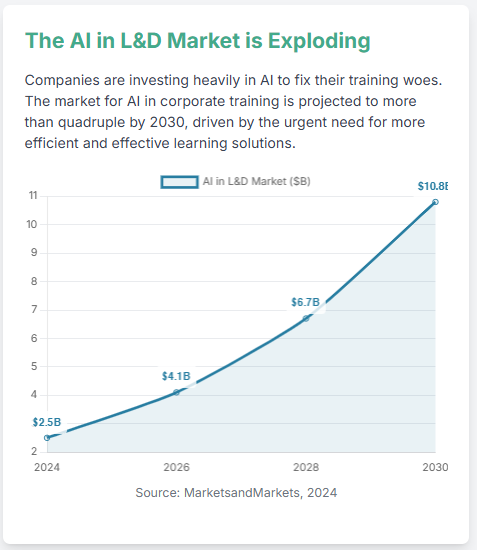
The market for AI in corporate training is projected to more than quadruple by 2030 (from $2.5B in 2024 to $10.8B) driven by the urgent need for more efficient and effective learning solutions.
But where is the money going? And is the solution really about adding "more AI?"
Where Most AI Tools Fall Short
Most current AI tools for L&D are fantastic at content creation and asynchronous (self-paced) learning. They can reduce content development time by up to 60% (Gartner, 2023). But they don't solve the engagement gap in live, synchronous sessions.
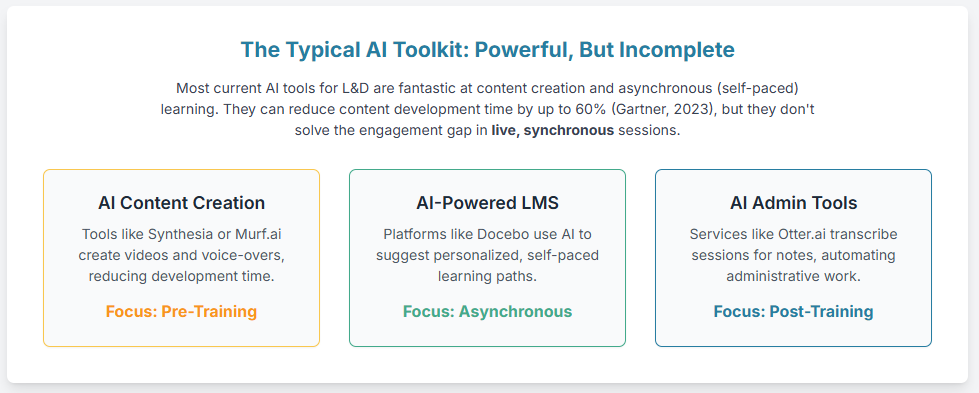
The typical AI toolkit covers content creation (tools like Synthesia for videos), AI-powered LMS platforms (like Docebo for personalized learning paths), and admin tools (like Otter.ai for transcription). But the live training moment (where attention is won or lost) remains largely unsolved.
The Hero of Hybrid Training: StreamAlive
For years, the standard advice for making online training "interactive" was to use a second-screen app like Mentimeter or Slido. You ask a question, and then you ask your learners to pick up their phones, scan a QR code, or open a new browser tab to vote.
It sounds minor, but that small action is a friction point. Every time you ask a learner to switch contexts, you lose a percentage of your audience to email, Slack notifications, or simple technical fatigue.
StreamAlive has taken a different approach: The Chat is the Controller.
The "9x" Engagement Metric
The impact of removing that friction is measurable.
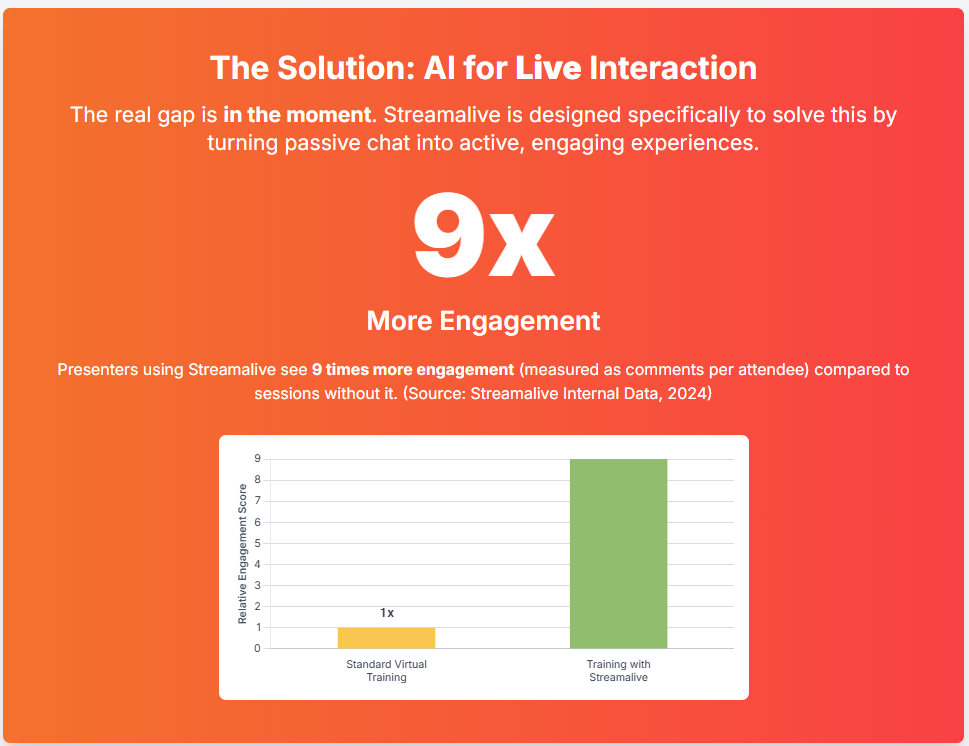
Data indicates that presenters and trainers using StreamAlive generate 9x more engagement in their sessions compared to those who don't.
Note on the metric: Engagement here isn't just a vague feeling; it is calculated based on the number of comments per attendee. Because StreamAlive reads the native chat of Zoom, Teams, or Google Meet, interacting is as easy as typing a word. There is no learning curve, no QR code, and no app to install for the learner.
How It Works (and Why Enterprises Like Nike Use It)
Instead of forcing users to a third-party polling site, StreamAlive uses AI to "listen" to the meeting chat in real-time.
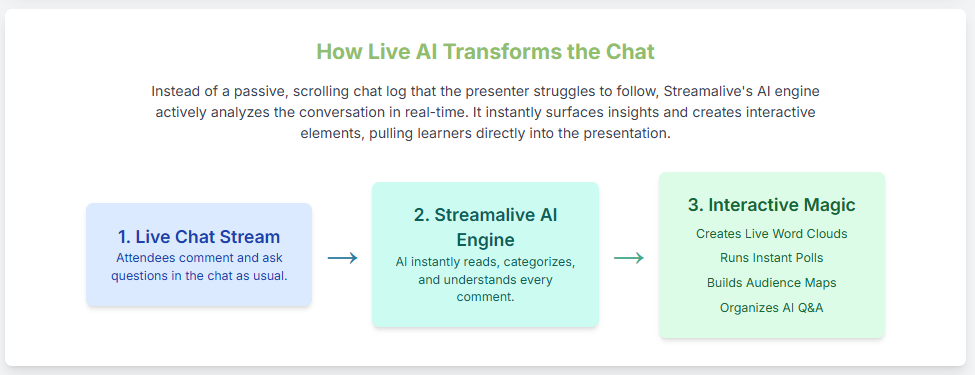
- Magic Maps: Ask "Where are you joining from?" and as people type cities in the chat, they instantly populate on a live map.
- Frictionless Polling: Ask a question, and the AI parses the chat answers into a real-time bar chart or word cloud.
- Visual Validation: Features like "Talking Tiles" light up when someone comments, giving learners that dopamine hit of being "seen" without needing to unmute.
This "zero-friction" approach has led to adoption by major organizations including Nike, Persistent Systems, and Symphony AI, who use it to maintain connection in hybrid sessions. Even YouTube creators like Airrack have used it to manage engagement with massive live audiences, proving its scalability.
Building the Complete AI L&D Stack
While StreamAlive solves the critical "Delivery" phase of training, a modern L&D team needs a full ecosystem. Based on our research, here are the best-in-class tools to handle the rest of your workflow.
1. The "Preparation" Phase: Gamma
The days of staring at a blank PowerPoint slide are over. Gamma is the standout tool for rapid content generation.
- Why it works: It uses a card-based system rather than rigid slides. You can paste a policy document or a rough outline, and Gamma generates a polished, professional presentation in minutes.
- Best for: Rapidly creating "just-in-time" training materials where speed is critical.
2. The "Scale" Phase: Synthesia
Video is essential, but re-shooting a video every time a product updates is a nightmare. Synthesia solves this with AI avatars.
- The Killer Feature: SCORM Export. unlike many AI video tools, Synthesia allows you to export your AI-generated videos as SCORM packages. This means you can upload them directly to your LMS and track learner completion rates just like a traditional course.
- Best for: Evergreen content like compliance training that needs frequent, small updates.
3. The "Practice" Phase: Yoodli
Roleplay is often the most dreaded part of soft-skills training. Yoodli offers a safe space for employees to practice.
- How it works: It acts as a private, AI-powered communication coach. A sales rep can practice their pitch, or a manager can practice a difficult feedback conversation, and the AI provides objective data on their pacing, filler words, and eye contact.
- Best for: Scaling coaching without needing to hire human mentors for every employee.
4. The "Analysis" Phase: Read.ai
How do you know if your training actually landed? Read.ai joins your sessions and analyzes the "room."
- The Insight: It goes beyond transcription to measure participant sentiment and engagement. It can tell you if your instructor is "monotone" or if the audience tuned out at the 20-minute mark.
- Best for: Auditing the quality of your VILT sessions and coaching your trainers.
The Bottom Line
The "AI Gap" in the workforce is real. Employees want to learn, but traditional, passive webinars are failing to hold their attention.
The winning strategy for 2025 is to build a technology stack that respects your learner's attention. Use Gamma to build content fast, Synthesia to scale video, Read.ai to measure impact, and—most crucially—StreamAlive to turn those passive listeners into active participants.
When you remove the friction, you don't just get better attendance; you get 9x the engagement. And in the attention economy, that is the only metric that matters.

The future of L&D isn't just AI-generated content; it's AI-driven interaction.

.svg.png)


