Install StreamAlive for your PowerPoint slides
Learn more

Siloed Experimentation Training for Training Agencies
StreamAlive helps 9x the audience engagement in your Virtual Instructor-led Trainings (VILT) directly inside your powerpoint presentation.
Make your instructor-led Siloed Experimentation training more fun with polls, word clouds, spinner wheels and more
Works inside your existing PowerPoint presentation
Install the StreamAlive app for PowerPoint and see your slides come to life as people participate in your interactions
AI generates audience interactions for you
Let our AI scan your presentation and automatically come up with relevant questions based on the content. Or spend two hours coming up with your own questions, your choice!
Built to work with MS Teams and Zoom
Native apps for Teams and Zoom so you never have to leave your existing workflows
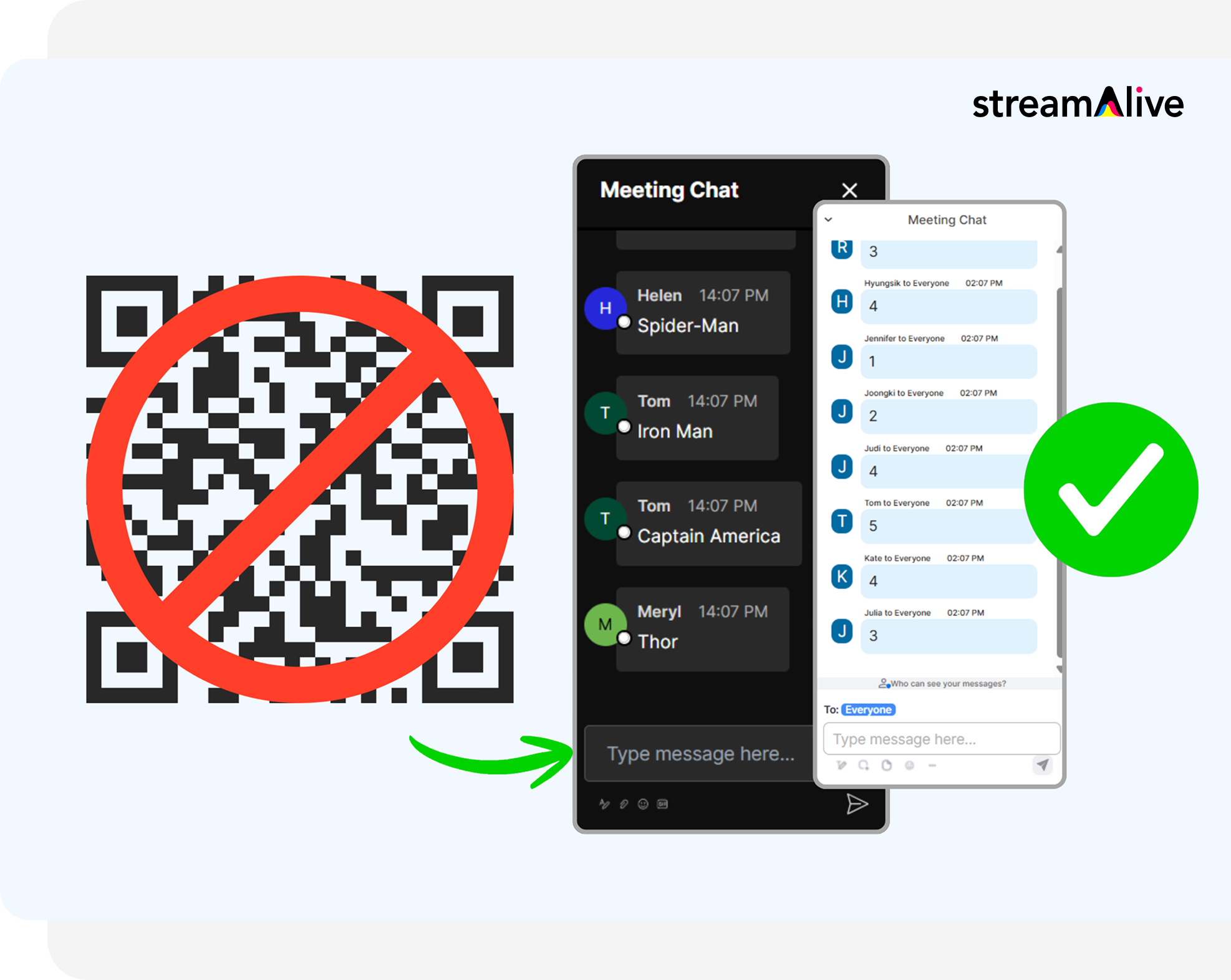
No QR Codes
Chat-powered interactions means your audience doesn’t need to scan QR codes or look at another screen to participate. They just type in the chat!
Quickly approved by your IT team
StreamAlive’s apps for Teams and Zoom means that they have been through rigorous quality assurance and client safety reviews. You’ll find everything an IT team needs to approve the app within the organization within your StreamAlive account.

Youve been asked to run a Siloed Experimentation instructor-led training for a training agency-and you already know the risk: it can get theory-heavy fast. The good news? With a few simple StreamAlive interactions, you can keep people clicking, typing, reacting, and actually thinking the whole way through.
Magic Maps: Put Your Training Agency Crowd on the Map (and instantly wake up the room)
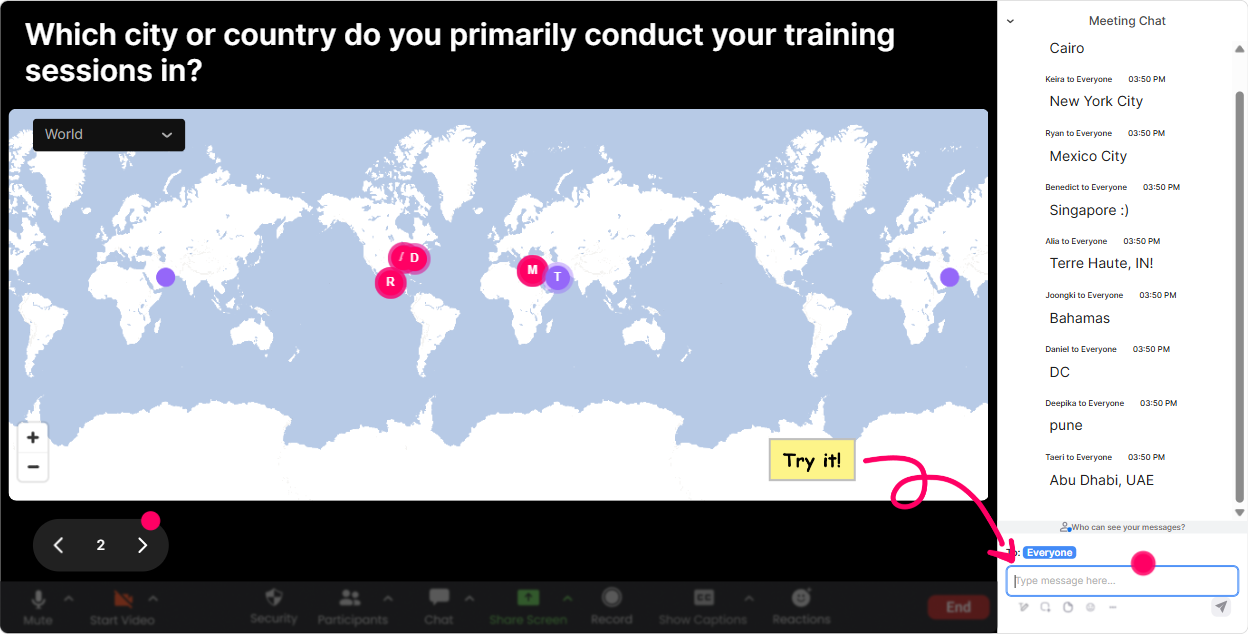
Start with the easiest engagement win of all: get them to type something in chat within the first 60 seconds. **How to use it in Siloed Experimentation training:** - Ask: **Where are you joining from today?** and let StreamAlive plot everyone live. - Then tie it back to your topic: **Drop the city where your experiments usually happen-Marketing, Sales, Product, L&D wherever you sit.** (They can answer with a location first, then you verbally bridge to the silo idea.) - Or use a fun twist: **If you could teleport to any city to study the best experimentation culture, where would you go?** **Why it works:** its warm, human, and visual. Plus, once people chat once, theyre way more likely to chat again. **Trainer tip:** If your group is big, those location clusters are gold-call out the hotspots (Weve got a Toronto cluster!) and youve built connection before youve even defined the term siloed experimentation.
Rating Polls: Get a Fast Pulse Check on Experimentation Maturity
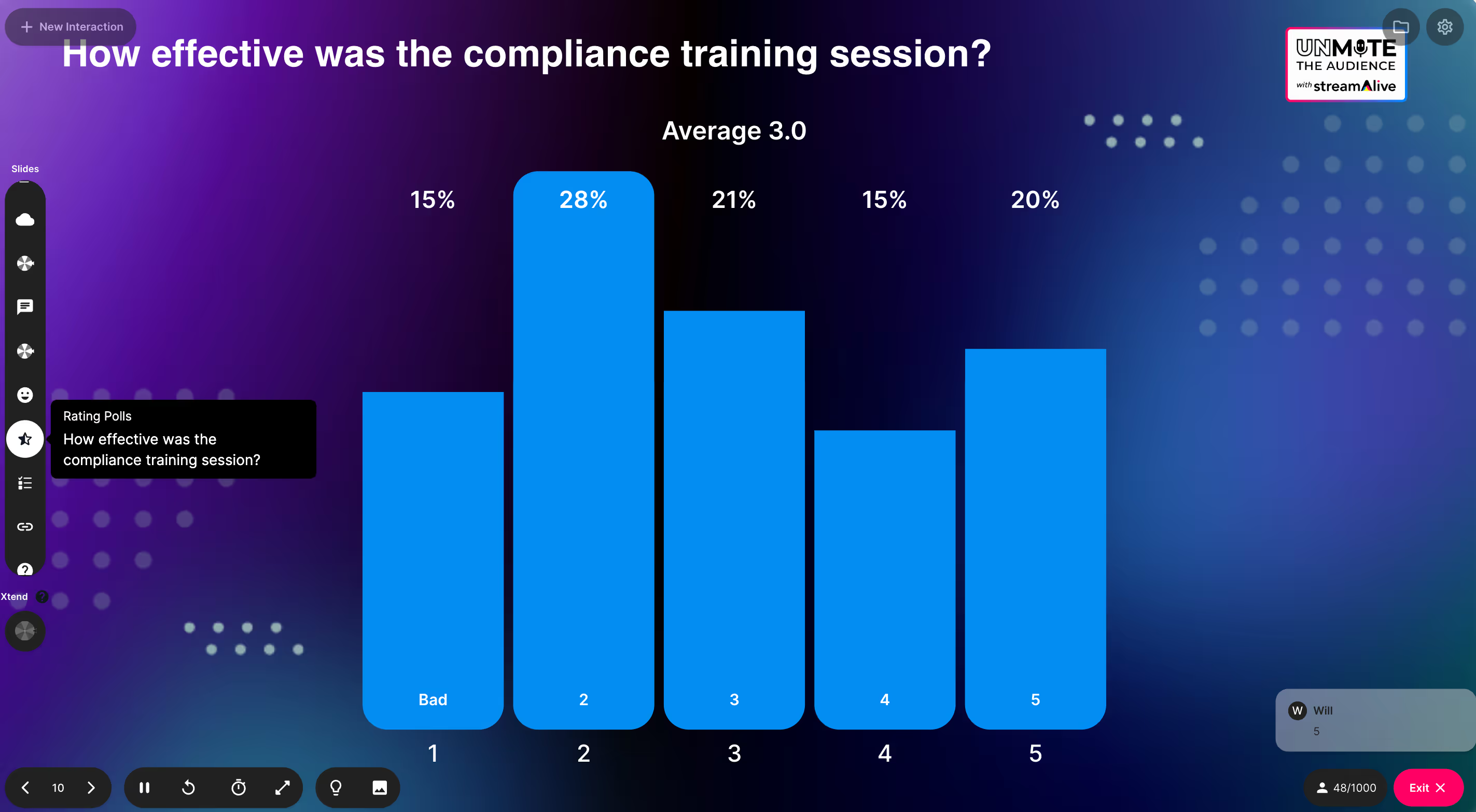
Before you dive into frameworks, find out where people really are. Rating Polls make this super quick-no long surveys, no awkward silence. **How to use it in your session:** - Ask: **On a scale of 110, how confident are you that your org runs experiments in a coordinated way?** - Ask: **Rate your current experimentation process (1 = chaotic, 10 = repeatable and well-documented).** - Midway pulse check: **How clear is the difference between testing and learning so far? (110)** **What you do with the results:** - If the average is low, you slow down and add examples. - If its high, you can challenge them with tougher scenarios (like cross-team prioritization and shared metrics). Its also a sneaky way to keep everyone with you-because theyre constantly answering, not just listening.
Wonder Words (Word Cloud): Make the Rooms Honest Feelings Visible
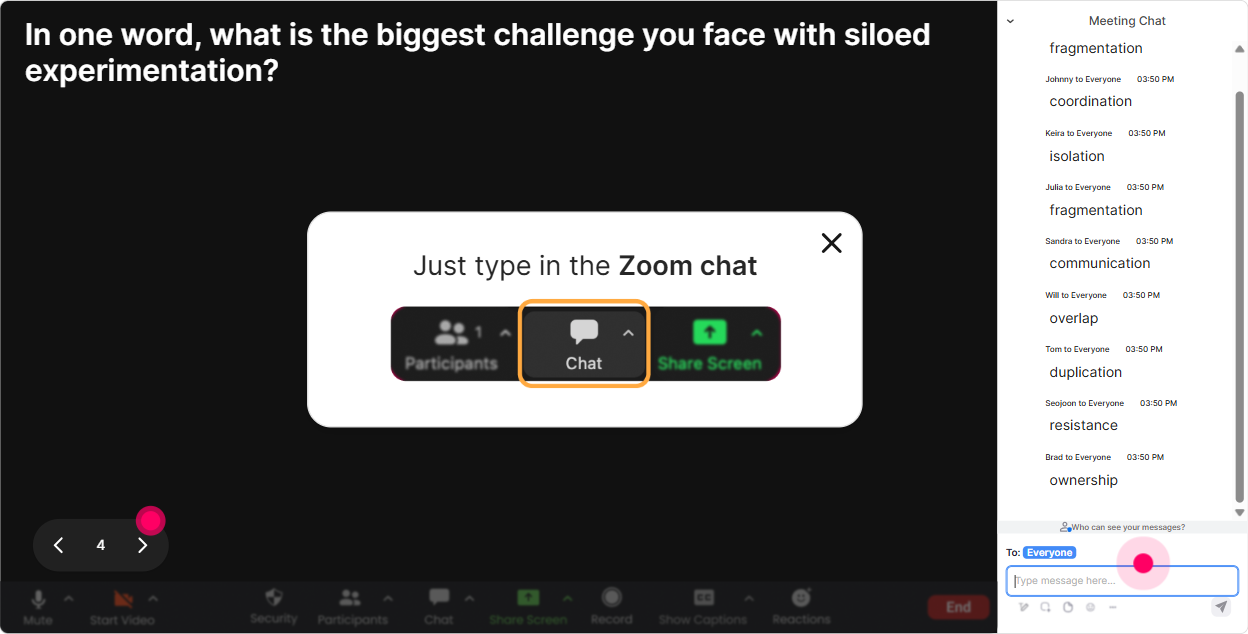
Siloed experimentation can trigger real feelings: frustration, confusion, we tried that, or even fear of blame. A word cloud lets people say it quickly without writing essays. **Great prompts for this topic:** - **When you hear siloed experimentation, what word comes to mind?** - **Whats the biggest blocker to running shared experiments in your org?** (Expect: politics, tools, data, ownership, time.) - **One word for how experimentation feels at your company today.** **How to use the results live:** - Call out the biggest words: Okay, ownership is HUGE. Lets talk about experiment ownership models. - Use it to normalize the pain: If you typed politics, youre not alone-this is exactly why were here. This turns your session into their session, not just your slides.
Talking Tiles: Turn Real Problems into Live Training Material
Talking Tiles is perfect when you want more than one-word answers-like mini stories, examples, or messy real-world situations (which is basically all of experimentation work). **Use it to pull practical context from training agency teams:** - Ask: **Whats one experiment your team ran that another team didnt know about?** - Ask: **Where do experiments get stuck in your org-approval, data access, stakeholder buy-in, or rollout? Explain in one sentence.** - Ask: **Describe a time two teams tested the same thing (or conflicting things) without realizing.** **Why its great:** Youre collecting case studies in real time. You can literally point at the tiles and say, This one right here-duplicate tests-lets use it to build a shared experimentation backlog. It also helps quieter folks participate because typing is easier than unmuting.
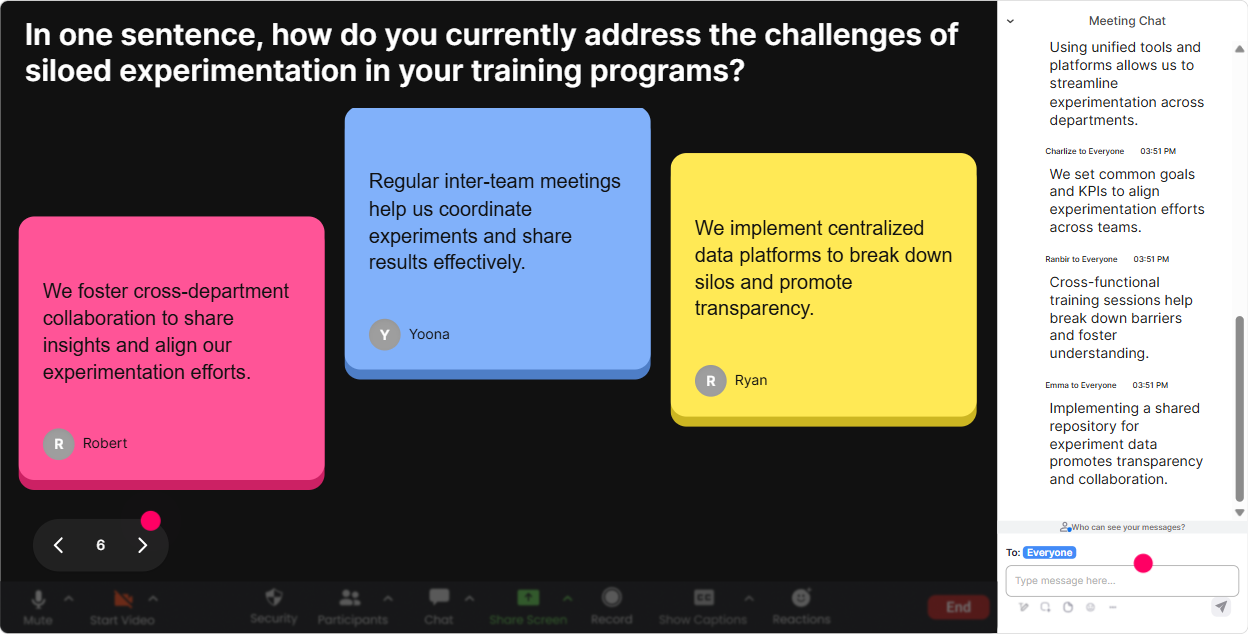
Power Polls: Let Them Choose What to Go Deeper On (and keep buy-in high)
Siloed experimentation has a bunch of angles-process, governance, metrics, tools, culture. Dont guess what they want. Ask them. **Poll ideas that work really well:** - **Whats your #1 goal today?** 1) Reduce duplicate experiments 2) Standardize metrics 3) Set up governance/decision rights 4) Build a shared experiment backlog 5) Improve learning documentation - **Where does experimentation live right now?** 1) Marketing 2) Product 3) Data/Analytics 4) Multiple teams, but disconnected 5) Nowhere formal - **Which part of the experimentation lifecycle is most siloed?** 1) Ideation 2) Prioritization 3) Design 4) Analysis 5) Sharing learnings **How this boosts engagement:** When people see their choice winning in real time, they feel like the session is responding to them-not happening to them.
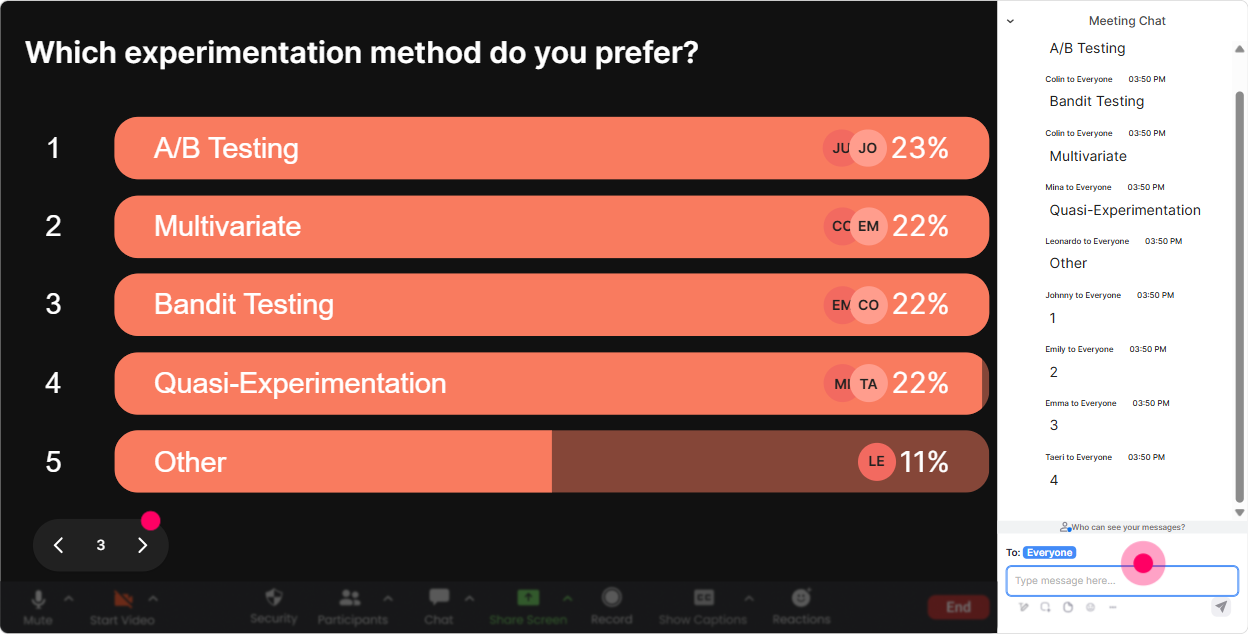
Winner Wheel (Spinner Wheel): Get Volunteers Without the Awkward Silence
You know that moment: you ask a question, and everyone suddenly becomes deeply interested in their mute button. Winner Wheel fixes that-while keeping it fun and fair. **How to use it in this training:** - Say: **Drop ME in chat if youre open to sharing a quick example of an experiment in your org.** Then spin the wheel. - Or: **Type one word describing your biggest experimentation headache. Ill spin the wheel and ask one person to unpack theirs for 30 seconds.** - End-of-section reflection: **Who wants to summarize the difference between local optimization and org learning?** (Let the wheel pick from chat participants.) **Trainer tip:** Keep it light and give people an out: You can pass if you want-no stress. The point is participation, not pressure.
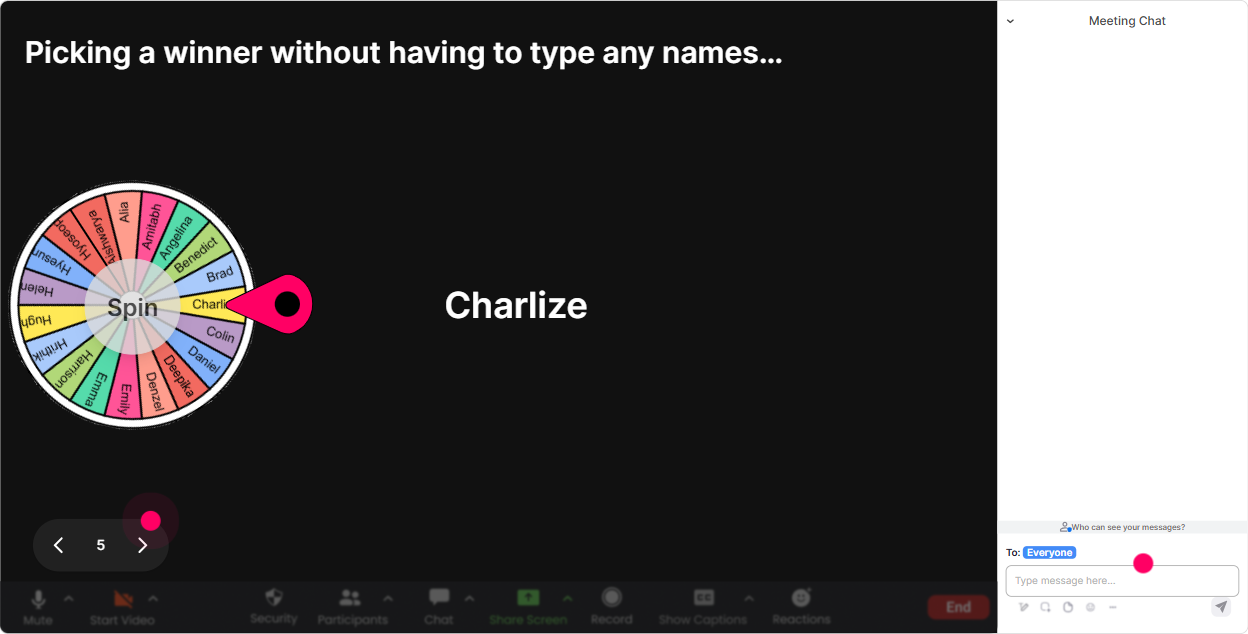
Quiz: Quick Knowledge Checks That Dont Feel Like School
A short quiz wakes people up instantly-especially after youve explained a model like governance, shared metrics, or experimentation documentation. **Quiz questions you can use in Siloed Experimentation ILT:** - **Question:** Which is the BEST example of siloed experimentation? - A) Teams use a shared metric dictionary and share results weekly - B) Marketing runs tests with a different success metric than Product, and results arent shared - C) A centralized repository stores all experiment learnings - D) Teams align on a single north star metric before testing **Correct answer:** B - **Question:** Whats the biggest risk of siloed experiments? - A) Faster decisions - B) More creativity - C) Conflicting changes and misleading learnings - D) Better documentation **Correct answer:** C **Why it works:** you get instant feedback on what landed-and it creates a natural moment for discussion (Why did you choose A?).
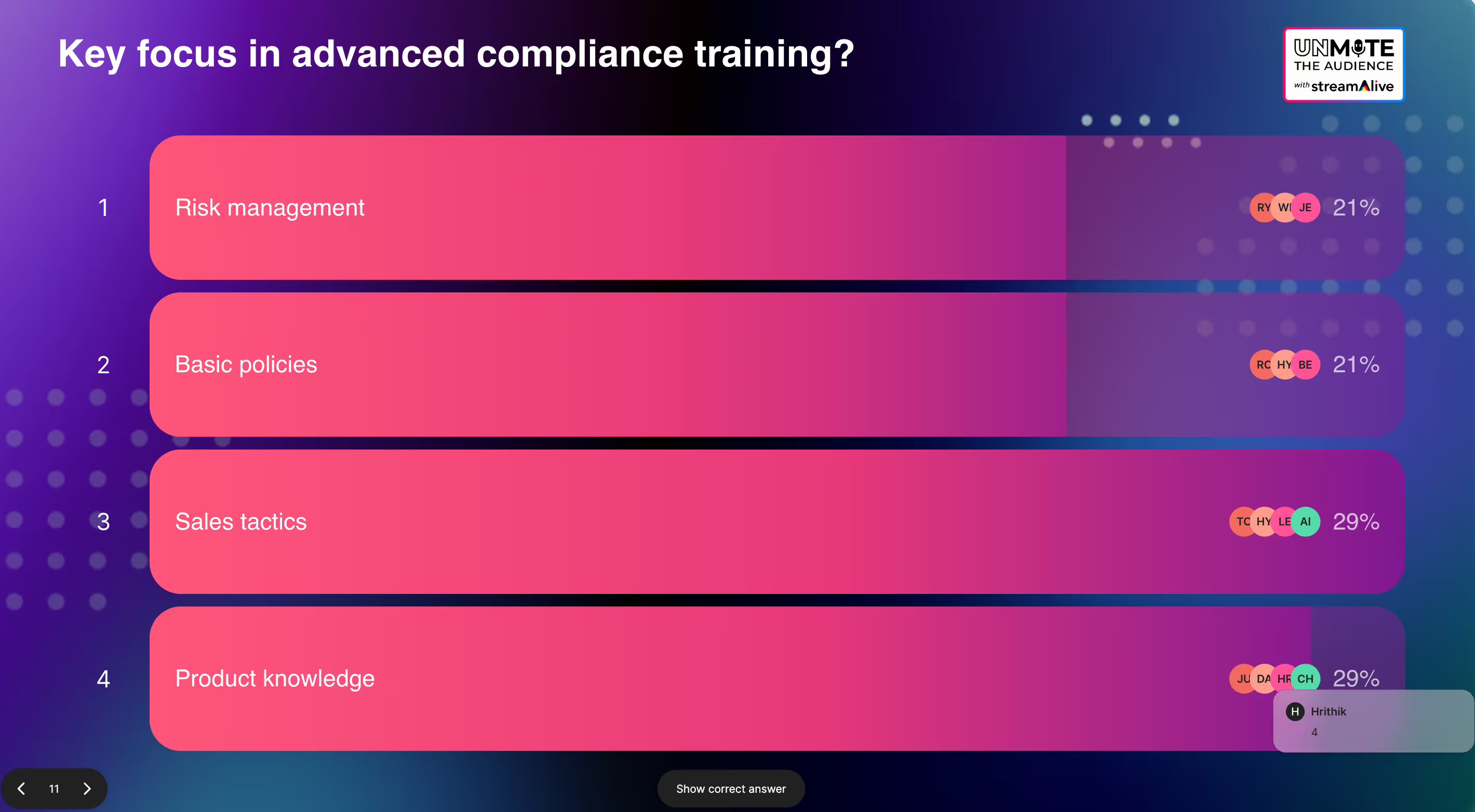
Rating Polls: Get a Fast Pulse Check on Experimentation Maturity
Before you dive into frameworks, find out where people really are. Rating Polls make this super quick-no long surveys, no awkward silence. **How to use it in your session:** - Ask: **On a scale of 110, how confident are you that your org runs experiments in a coordinated way?** - Ask: **Rate your current experimentation process (1 = chaotic, 10 = repeatable and well-documented).** - Midway pulse check: **How clear is the difference between testing and learning so far? (110)** **What you do with the results:** - If the average is low, you slow down and add examples. - If its high, you can challenge them with tougher scenarios (like cross-team prioritization and shared metrics). Its also a sneaky way to keep everyone with you-because theyre constantly answering, not just listening.
Q&A: Catch Every Question Without Playing Chat Detective
When youre teaching something like experimentation governance or shared metrics, people will have questions-lots of them. StreamAlives Q&A (Quick Questions) pulls questions from chat and lists them cleanly so you dont miss the good ones. **How to use it in your flow:** - Tell the group: **Drop questions in chat anytime-StreamAlive will capture them and Ill do Q&A at the end of each section.** - Do a structured Q&A after key modules: - After Why silos happen - After How to set shared metrics - After How to build an experiment intake + backlog **Trainer win:** You stay focused on teaching instead of scrolling through chat trying to find that one question someone asked five minutes ago.

Analytics: Prove What Worked, Fix What Didnt (and Improve Every Delivery)
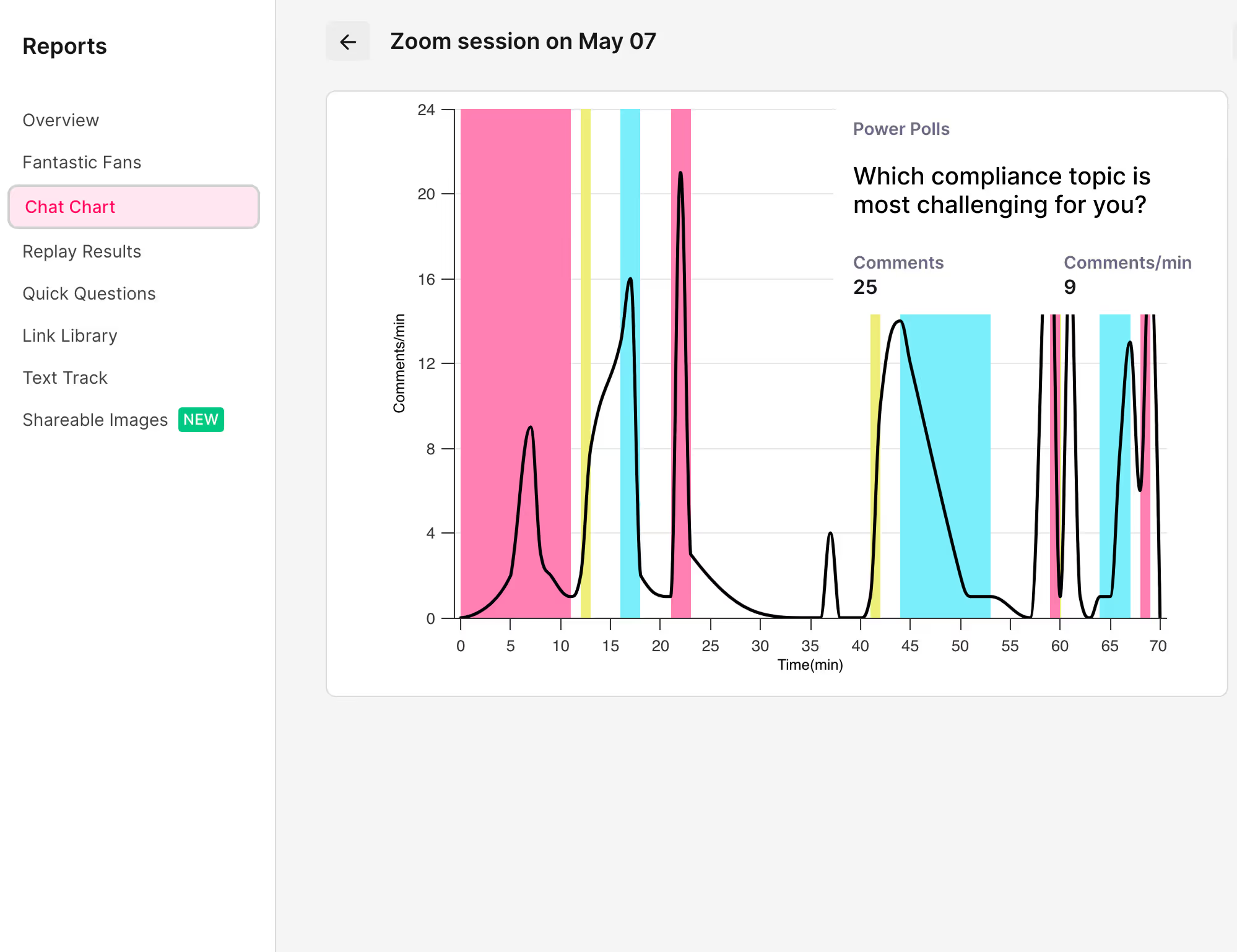
If you run trainings for training agencies (or you deliver internally a lot), analytics are your secret weapon. StreamAlive shows you engagement minute-by-minute, which interactions got people talking, and who your most engaged participants were. **How to use Analytics after a Siloed Experimentation session:** - Spot the exact moment engagement dipped (maybe your governance slide got too dense) and tighten it next time. - See which interaction performed best-maybe Wonder Words got tons of responses, but your poll didnt. That tells you how your audience likes to engage. - Identify your **Fantastic Fans** (your most engaged people). Those are often your champions-great folks to involve in follow-up sessions or pilot groups. - Export/share the interaction results with your team via email, or use the chat replay to pull real quotes for your debrief. Bottom line: youre not guessing anymore. Youre iterating on your training the same way you want them to iterate on experiments.
Use StreamAlive in all your training sessions
StreamAlive isn’t just for
Siloed Experimentation
training,
it can also be used for any instructor-led training session directly inside your PowerPoint presentation.
Explore similar traingin ideas: unlocking the potential of StreamAlive
See how StreamAlive transforms live training with engaging events and interactive sessions across industries, directly inside your PowerPoint presentation.

Interactions in action
(it's free)

.svg.png)


