Install StreamAlive for your PowerPoint slides
Learn more

Psychological Safety Training for Corporate Trainers
StreamAlive helps 9x the audience engagement in your Virtual Instructor-led Trainings (VILT) directly inside your powerpoint presentation.
Make your instructor-led Psychological Safety training more fun with polls, word clouds, spinner wheels and more
Works inside your existing PowerPoint presentation
Install the StreamAlive app for PowerPoint and see your slides come to life as people participate in your interactions
AI generates audience interactions for you
Let our AI scan your presentation and automatically come up with relevant questions based on the content. Or spend two hours coming up with your own questions, your choice!
Built to work with MS Teams and Zoom
Native apps for Teams and Zoom so you never have to leave your existing workflows
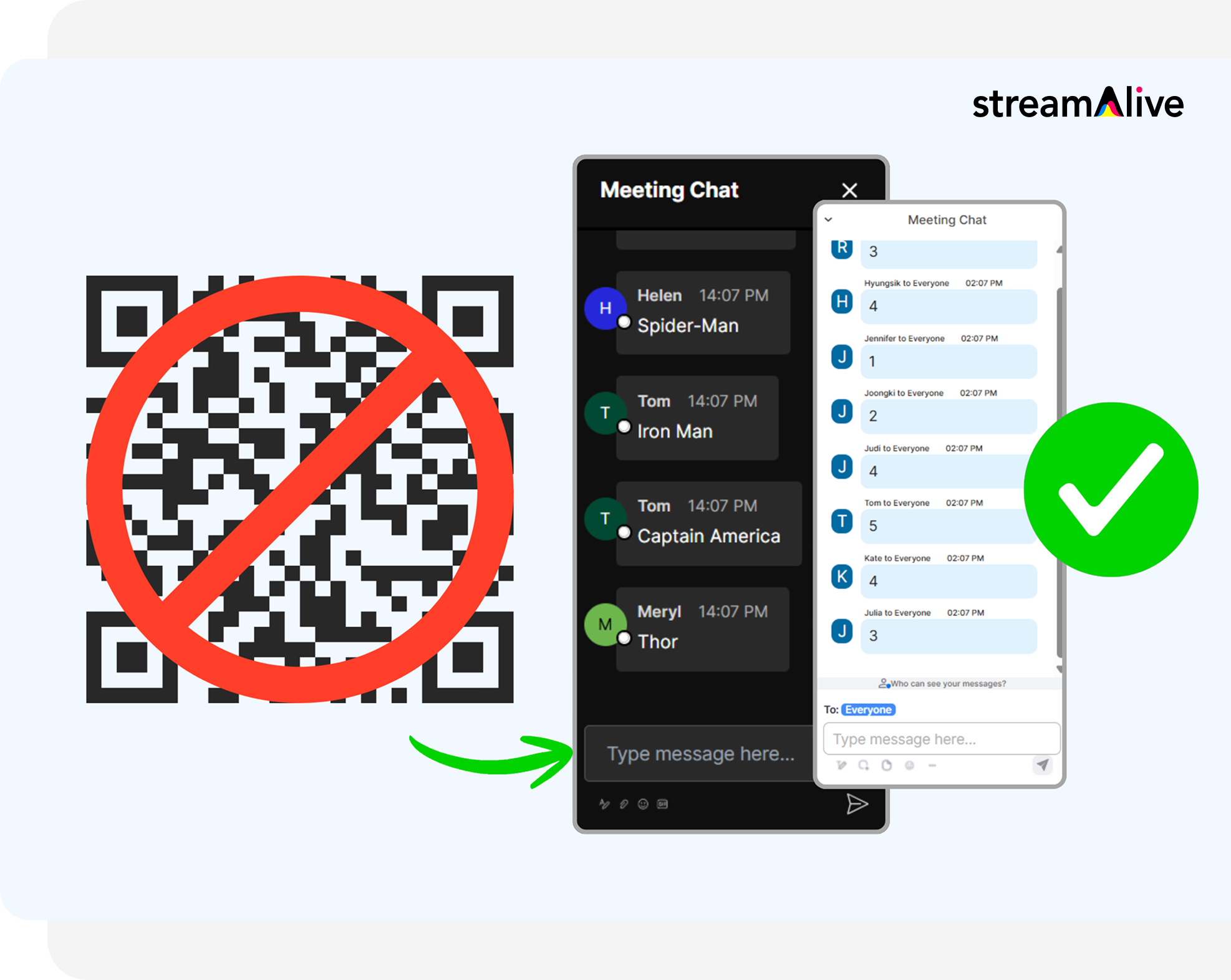
No QR Codes
Chat-powered interactions means your audience doesn’t need to scan QR codes or look at another screen to participate. They just type in the chat!
Quickly approved by your IT team
StreamAlive’s apps for Teams and Zoom means that they have been through rigorous quality assurance and client safety reviews. You’ll find everything an IT team needs to approve the app within the organization within your StreamAlive account.
Youve been asked to run a Psychological Safety instructor-led training for corporate trainers-and you want it to feel real, not like another slide parade. The goal is simple: get people talking, sharing, and practicing the skills live. Here are practical ideas (with StreamAlive) to keep your room engaged from minute one.
Magic Maps: Start Psychological Safety by making the room feel human
Psychological Safety starts with one thing: I belong here. Magic Maps helps you do that in the first 60 seconds. How to use it in your session: - Kickoff question: Where are you joining from today? (simple, low-risk, everyone can answer) - Make it relevant: Pick a city where you felt most comfortable speaking up at work. - Or keep it playful: If you could teleport to a place that feels safe and calm right now, where would you go? Trainer move: As the map fills up, comment on clusters (Looks like weve got a strong Toronto crew!). It creates instant warmth and reduces that awkward silent room vibe-huge for Psychological Safety training. Bonus tip: If youre training internal trainers across regions, use the map to naturally talk about cultural differences in speaking up (without putting anyone on the spot).

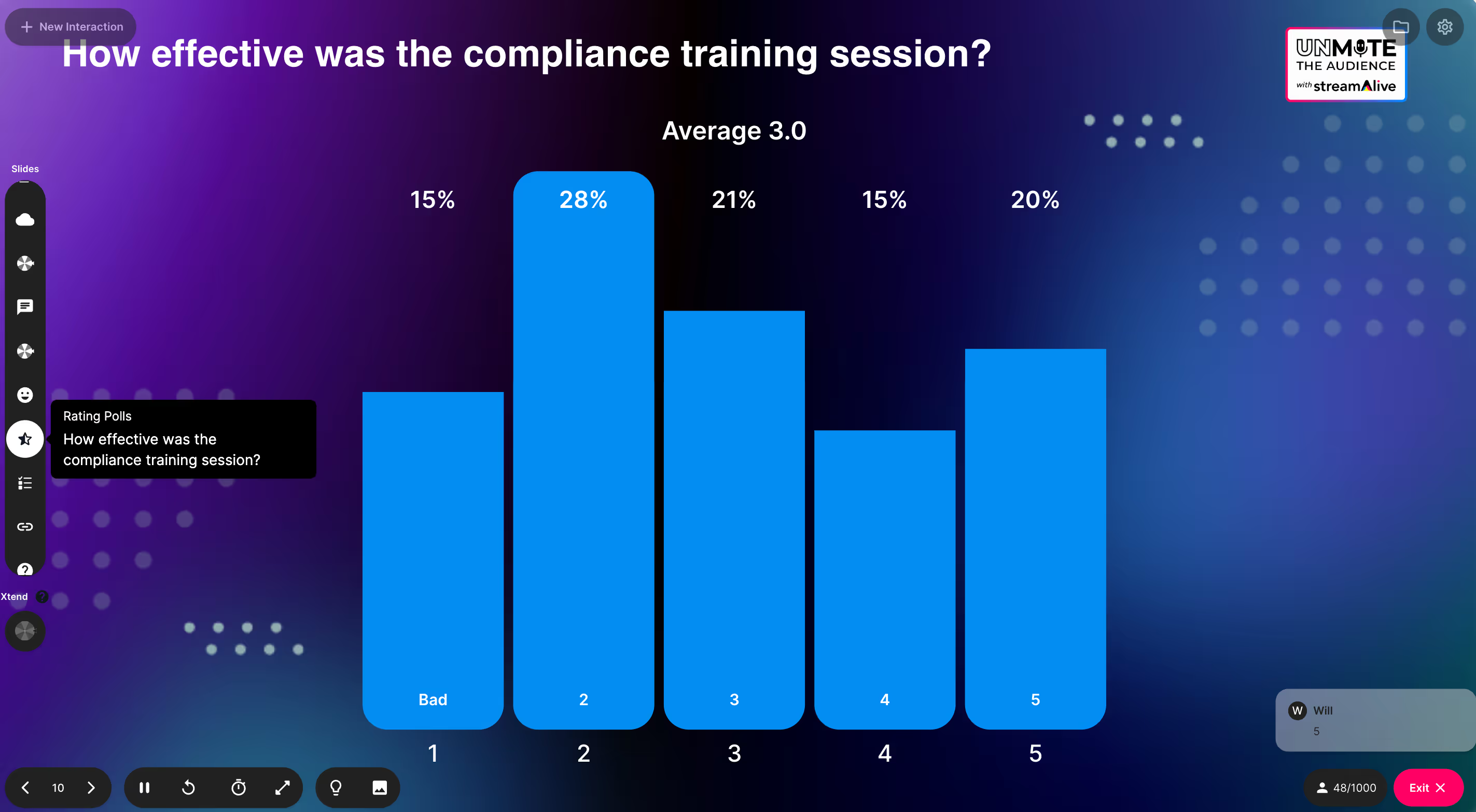
Rating Polls: Get an honest pulse check-fast
In Psychological Safety training, people often nod along but you need to know what they really think. Rating Polls give you a quick temperature check without asking people to explain themselves right away. Ideas you can run as Rating Polls: - On a scale of 110, how safe do you feel speaking up in your current team? - How confident are you at responding when someone challenges your idea? - How comfortable are you facilitating a tough conversation as a trainer? Trainer move: After results show, dont judge the numbers-normalize them. Say something like, Totally fair. If youre at a 4, youre exactly who this session is for. That response alone models Psychological Safety. Pro tip: Run the same rating at the end to show progress. People love seeing a shift in the room.
Wonder Words (Word Cloud): Surface emotions without making it awkward
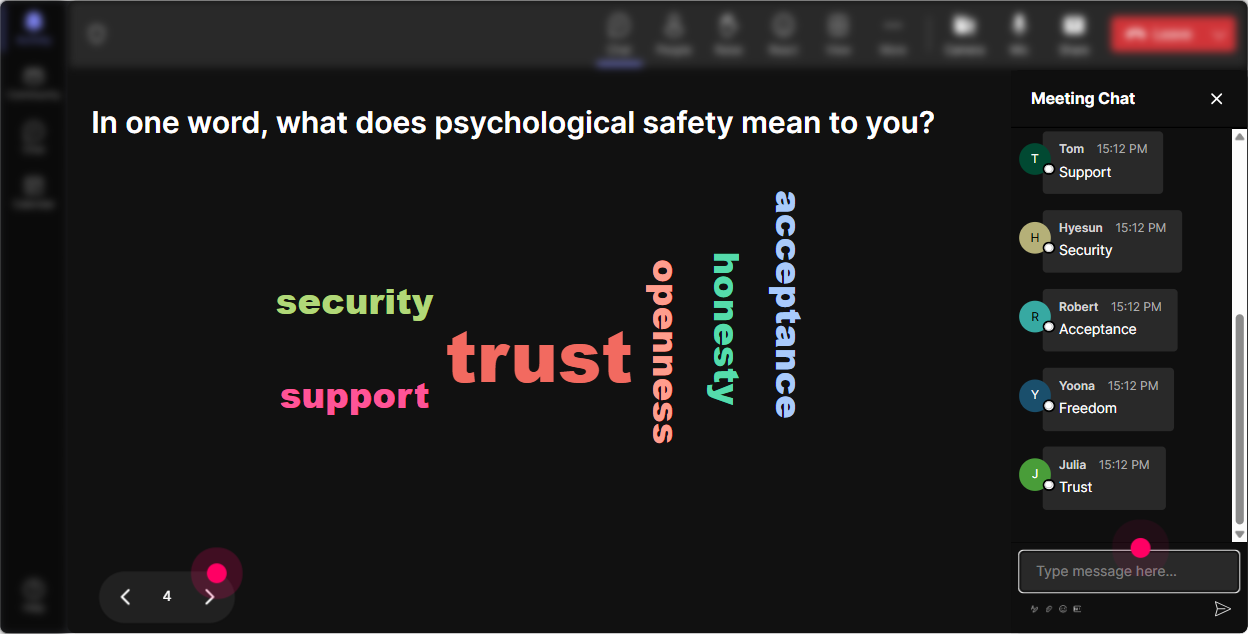
This is one of the easiest ways to get people participating because its quick and low-pressure-perfect for sensitive topics like Psychological Safety. Try prompts like: - When you hear Psychological Safety, whats one word that comes to mind? - One word: what stops people from speaking up in training sessions? - One word: what do great facilitators do to help people feel safe? Trainer move: When the word cloud forms, read it out loud like youre reflecting the room: Im seeing fear, judgment, trust, respect yeah, that tracks. Why it works: Youre letting the group say the hard stuff without forcing anyone to tell a personal story in front of everyone on day one.
Talking Tiles: Turn the chat into a real conversation (without forcing anyone to unmute)
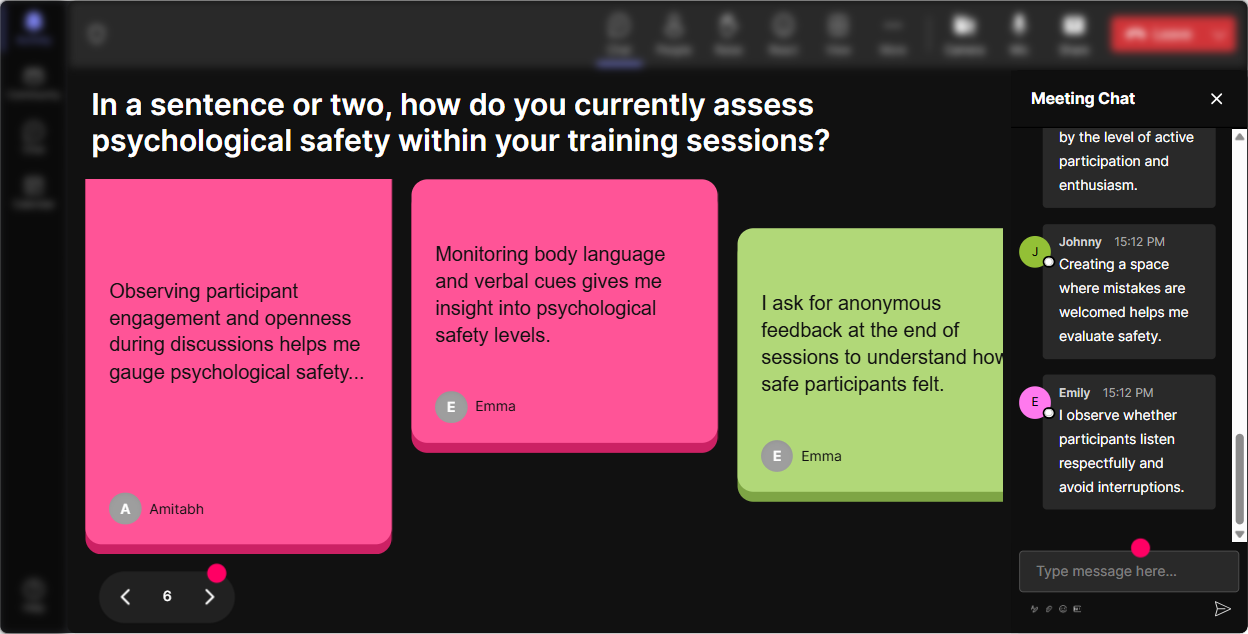
Psychological Safety becomes real when people can describe what it looks like in their day-to-day work. Talking Tiles is awesome for that because it makes longer responses feel fun and visible-like the room is building ideas together. Prompts that work really well: - Finish this sentence: I feel safe to speak up when the trainer/facilitator ____. - Whats one small thing a leader does that kills Psychological Safety instantly? - Share a moment (short!) when you held back in a meeting-what was the risk you felt? - As a trainer, whats one phrase you use to invite quieter voices in? Trainer move: Pick 23 tiles to read out and say, Thank you for putting that into words. That simple acknowledgment reinforces the behavior youre teaching. Also great for hybrid sessions: remote participants dont get sidelined because their messages literally show up on screen.
Power Polls: Let the group choose what to focus on (and model autonomy)
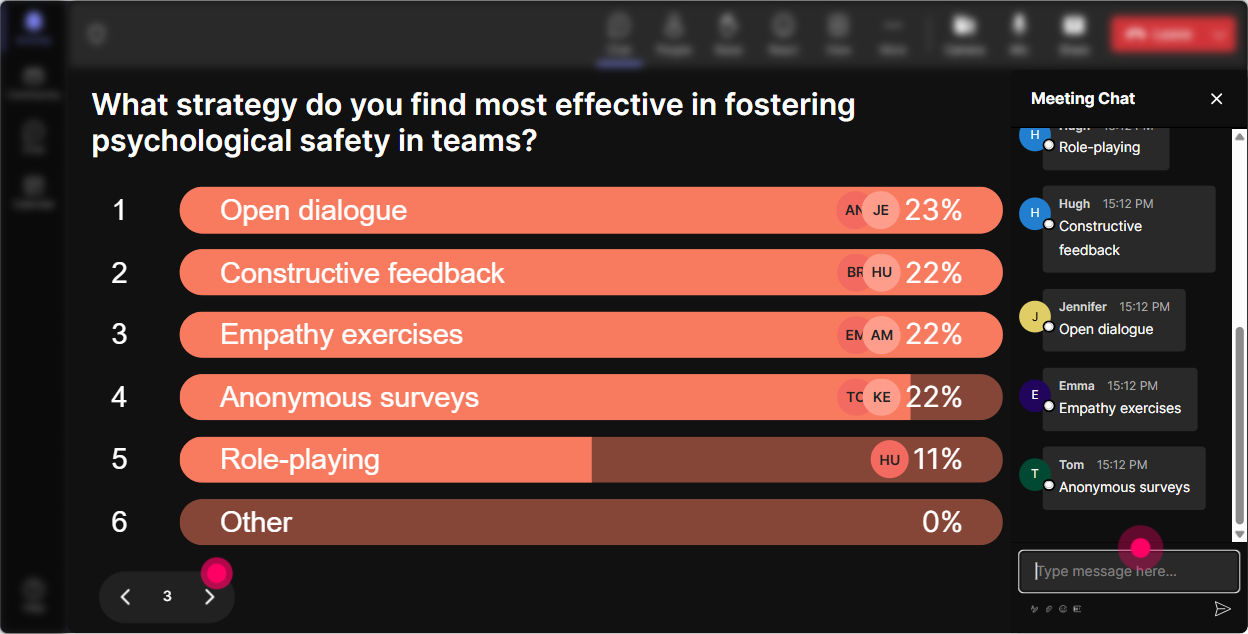
A big part of Psychological Safety is giving people voice and choice. Power Polls help you do that live-so the training feels like its happening with them, not at them. Poll ideas for your run-of-show: - What do you want to spend more time on today? 1) Speaking up in meetings 2) Responding to mistakes without blame 3) Handling conflict and pushback 4) Inclusion & belonging in group discussions - Whats hardest for you as a trainer? 1) Getting quiet groups to talk 2) Managing dominating voices 3) Addressing inappropriate comments 4) Facilitating feedback safely Trainer move: Commit to what they choose. Even 10 minutes. When you visibly adapt, youre demonstrating Psychological Safety in action: people spoke, and it mattered. If you want deeper nuance, you can follow the poll with: Why did you pick that? using chat or Talking Tiles.
Winner Wheel (Spinner Wheel): Invite participation without the cold-call fear
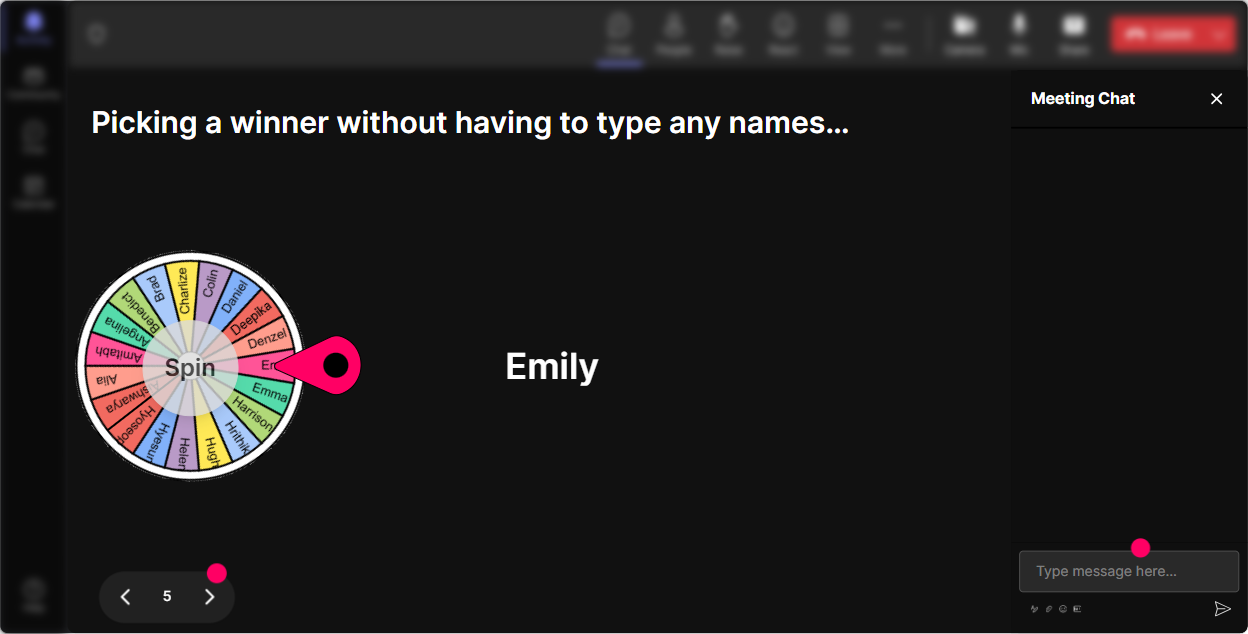
Cold-calling can spike anxiety-especially in Psychological Safety training (ironic, right?). But you still want voices in the room. The Winner Wheel makes it feel lighter and more fair. How to use it safely: - First, ask a chat question everyone can answer: Type one phrase you use to encourage questions. - Then spin: Lets have one person share their phrase out loud-wheel decides! Trainer moves that keep it psychologically safe: - Give an opt-out: If youd rather pass, just say pass-no problem. - Keep the ask small: 1020 seconds, not a five-minute monologue. - Use it for positive moments: Who gets to share a win-something that worked well in a tough group? Why it works: You still get live voices, but it doesnt feel like youre singling someone out for being quiet.
Quiz: Quick knowledge checks that spark discussion (not shame)
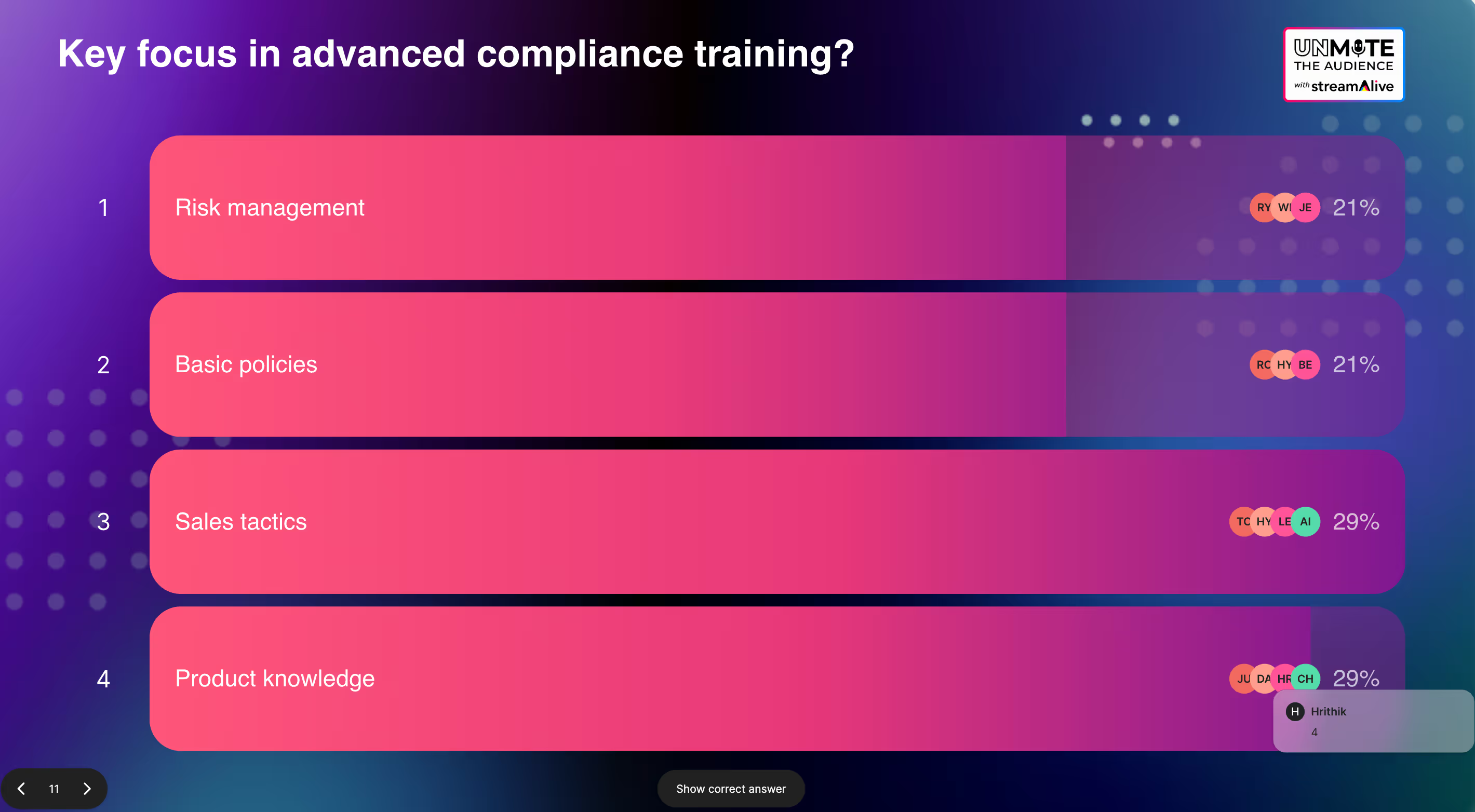
Quizzes are great in Psychological Safety training as long as you frame them right: This is practice, not a test. StreamAlives Quiz makes it easy to run fast checks and show results instantly. Multiple-choice questions you can use: - Whats Psychological Safety actually about? A) Being nice all the time B) Comfort and agreement C) Belief you can take interpersonal risks without punishment D) Avoiding conflict - Which behavior builds Psychological Safety the most? A) Immediately correcting people B) Asking curious follow-up questions C) Only praising top performers D) Ignoring tension - What should a facilitator do when someone makes a mistake in a group activity? A) Move on quickly B) Joke about it C) Thank them and normalize learning D) Ask who caused it Trainer move: After revealing the correct answer, ask: What makes the wrong answers tempting? That question creates great discussion without calling anyone out.
Rating Polls: Get an honest pulse check-fast
In Psychological Safety training, people often nod along but you need to know what they really think. Rating Polls give you a quick temperature check without asking people to explain themselves right away. Ideas you can run as Rating Polls: - On a scale of 110, how safe do you feel speaking up in your current team? - How confident are you at responding when someone challenges your idea? - How comfortable are you facilitating a tough conversation as a trainer? Trainer move: After results show, dont judge the numbers-normalize them. Say something like, Totally fair. If youre at a 4, youre exactly who this session is for. That response alone models Psychological Safety. Pro tip: Run the same rating at the end to show progress. People love seeing a shift in the room.
Q&A (Quick Questions): Catch the real questions people are hesitant to ask
In Psychological Safety sessions, people often have questions they dont want to say out loud (What if my manager is the problem?). StreamAlives Q&A feature pulls questions straight from chat and organizes them so you dont miss the important stuff. How to set it up for Psychological Safety training: - Tell them: Drop questions anytime in chat-StreamAlive will collect them for me. - Use prompts to unlock questions: - Whats the hardest Psychological Safety moment youve faced as a trainer? - What do you do when one person keeps shutting others down? - How do you handle Thats a dumb question energy in a room? Trainer move: Batch-answer. Say, Im seeing a theme: dealing with dominant voices. That helps people feel less alone. And because its captured automatically, you dont have to scroll chat and accidentally ignore someone (which can feel unsafe to participants).

Analytics: Prove what worked, improve what didnt (without guessing)
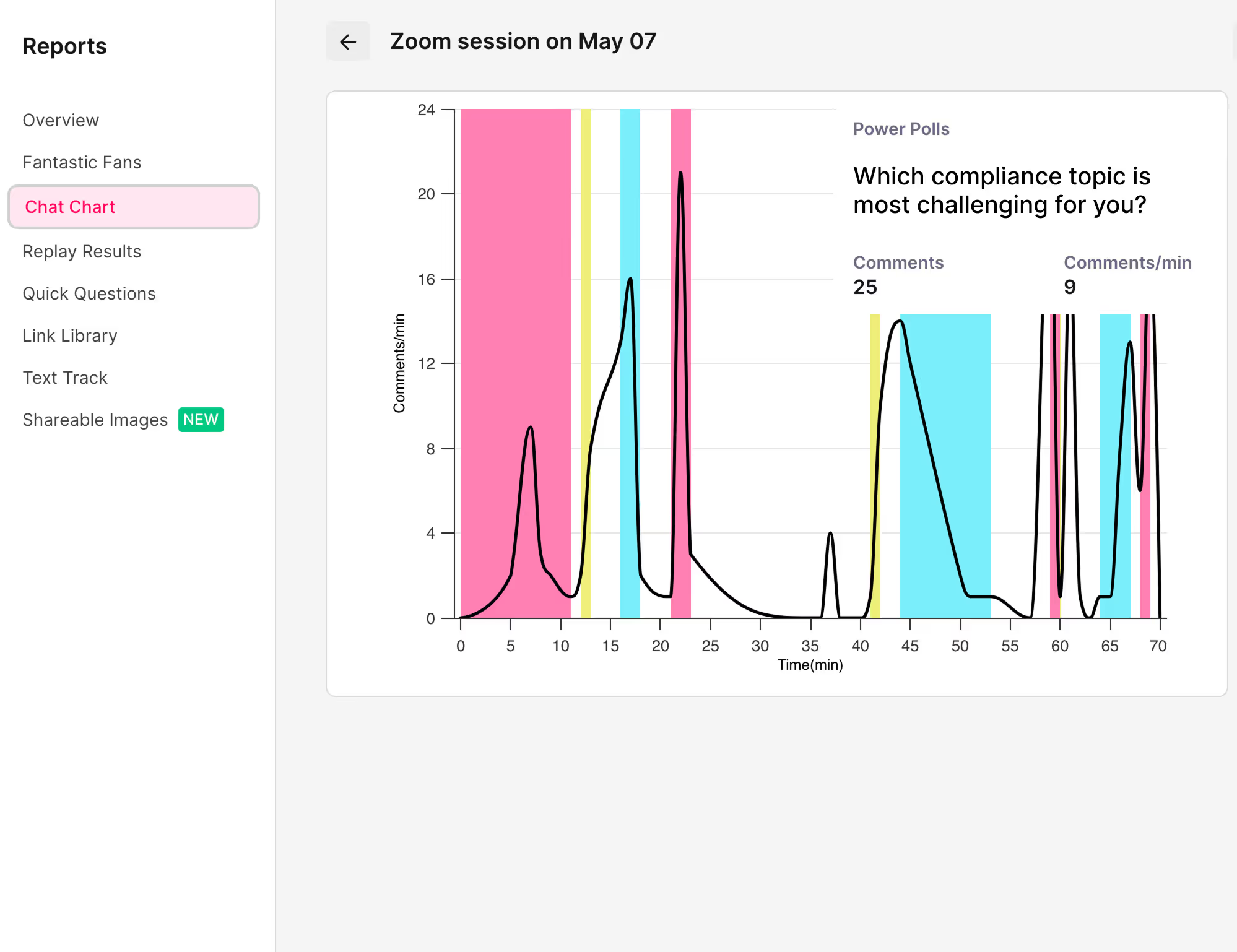
After your session, StreamAlive Analytics shows you what actually engaged the group-minute by minute-so you can refine your Psychological Safety training like a pro. Ways trainers can use analytics here: - See where engagement spiked: Was it the word cloud? The story share? The quiz? - Spot drop-off moments: If chat died during a lecture-heavy section, youll know exactly where to redesign. - Find your most engaged participants (your Fantastic Fans): These are your future champions-invite them to co-facilitate, share examples, or help reinforce Psychological Safety in the organization. - Export/share results: Send interaction summaries to your L&D team or stakeholders to show outcomes beyond people liked it. Trainer move: Use the data to improve Psychological Safety itself. For example, if participation is low early on, add a lower-risk opener next time (Magic Maps + Word Cloud is a strong combo).
Use StreamAlive in all your training sessions
StreamAlive isn’t just for
Psychological Safety
training,
it can also be used for any instructor-led training session directly inside your PowerPoint presentation.
Explore similar traingin ideas: unlocking the potential of StreamAlive
See how StreamAlive transforms live training with engaging events and interactive sessions across industries, directly inside your PowerPoint presentation.

Interactions in action
(it's free)

.svg.png)


